
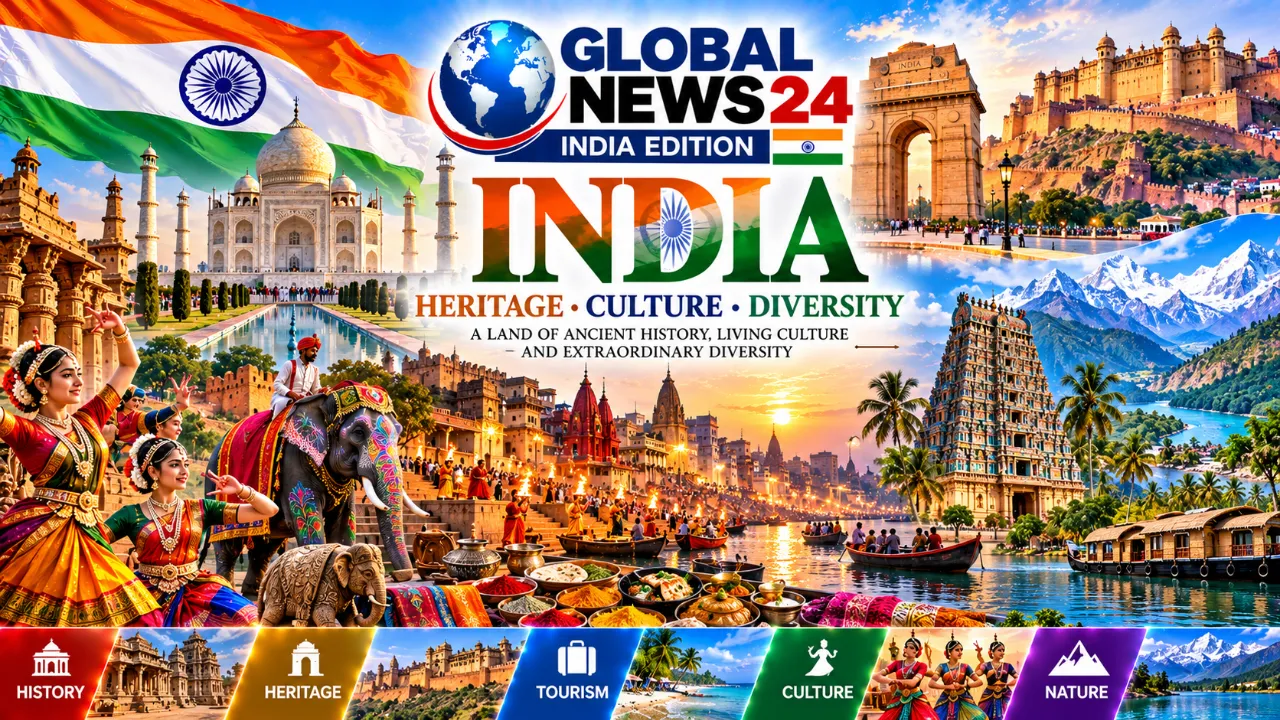
GLOBAL NEWS24 · INDIA EDITION
India is a country where ancient history and contemporary life exist side by side.
Across its vast territory, historic monuments, traditional arts, languages, architecture, food and regional customs reflect a cultural landscape shaped over many centuries.
For international visitors, discovering India can mean much more than visiting famous landmarks.
It can also be an opportunity to experience the diversity of communities, traditions and ways of life found across the country.
One of India's most internationally recognized landmarks is the Taj Mahal in Agra.
Its distinctive architecture and historical significance have made it one of the best-known symbols of Indian heritage around the world.
The capital region of Delhi offers another perspective on India's long history.
Historic structures, traditional neighborhoods and modern urban development exist within the same metropolitan landscape, allowing visitors to encounter different periods of Indian history in one place.
Other cities present very different cultural identities.
Jaipur, known for its historic architecture and distinctive urban character, forms part of a region strongly associated with palaces, forts, craftsmanship and cultural traditions.
Varanasi, located along the Ganges, represents another side of India's cultural history, with traditions and daily life closely connected to the river and the city's long past.
In southern India, historic temples, architecture and regional cultural traditions create landscapes that differ significantly from those of the north.
India's cultural diversity is also expressed through performing arts.
Traditional dance, music, textiles, crafts and regional artistic practices continue to form an important part of cultural life.
Food provides another window into this diversity.
Indian cuisine cannot be described as a single culinary tradition.
Ingredients, cooking methods and flavors vary widely from region to region, reflecting local geography, history and cultural practices.
Festivals also bring communities together through music, color, food and shared traditions.
Different regions and communities observe a wide variety of celebrations throughout the year, adding another dimension to India's cultural landscape.
Nature is equally important to the country's identity.
From the Himalayan region in the north to coastal areas, forests, deserts, rivers and tropical landscapes, India's geography is remarkably diverse.
This combination of cultural and natural heritage creates significant opportunities for tourism.
However, tourism also brings responsibility.
Historic monuments, traditional communities and natural environments need to be protected so that future generations can continue to experience them.
Responsible tourism can help visitors appreciate a destination while respecting its heritage, environment and local communities.
Digital media is also changing the way the world discovers India.
Images, videos and stories from local communities can now reach international audiences almost instantly, allowing lesser-known places and cultural traditions to become visible beyond national borders.
GLOBAL NEWS24 INDIA EDITION will continue to introduce India's history, culture, cities, heritage and diverse communities to readers around the world.
India's story is not represented by a single monument, city or tradition.
Its identity is found in the extraordinary diversity of people, places and cultural experiences that together form one of the world's most complex cultural landscapes.
GLOBAL NEWS24 · INDIA EDITION
Heritage · Culture · Diversity — Discovering India and connecting it with the world.