
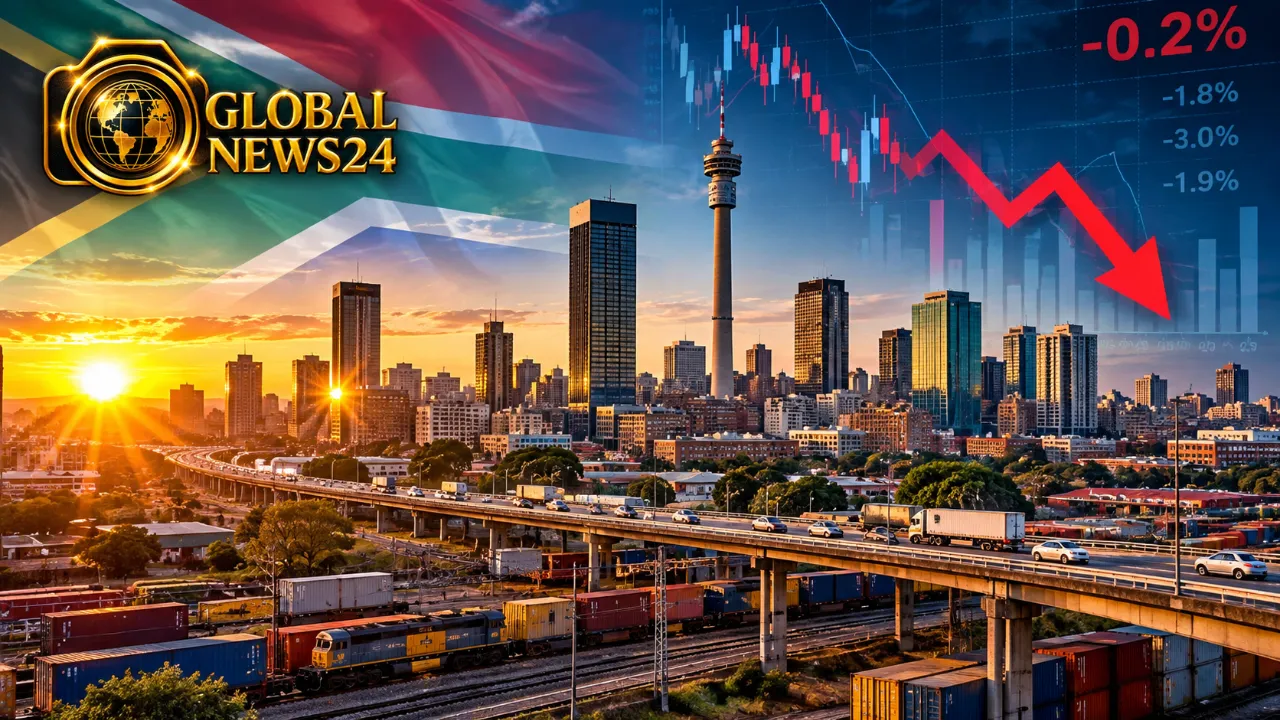
JOHANNESBURG — South Africa’s economy contracted in the second quarter of 2026, highlighting the continuing challenge of turning improvements in infrastructure and electricity supply into sustained economic growth.
Statistics South Africa reported that gross domestic product decreased by 0.2% in the second quarter, following growth of 0.4% in the first three months of the year.
Several major sectors recorded declines. The trade, catering and accommodation industry fell by 1.9%, while manufacturing decreased by 1.8%. Mining and quarrying contracted by 3.0%, with weaker activity reported in platinum group metals, manganese ore, gold and iron ore.
Other parts of the economy performed more positively. Transport, storage and communication increased by 0.9%, while finance, real estate and business services expanded by 0.3%. General government services and personal services also recorded growth.
The figures illustrate the mixed conditions facing Africa’s most industrialised economy. Improvements in electricity reliability and efforts to address transport and logistics constraints have strengthened parts of the operating environment, but weak performance in several production-intensive industries remains a concern.
Government and business have expanded cooperation around energy, logistics, mining, tourism, agriculture and infrastructure. Among the longer-term objectives are increased freight volumes, greater investment in transport infrastructure and additional electricity-grid capacity.
The latest GDP figures suggest that the success of those reforms will increasingly be measured by whether improvements in infrastructure translate into stronger investment, production and employment.
For South Africa, the challenge now is moving from economic stabilisation toward sustained and inclusive expansion.