
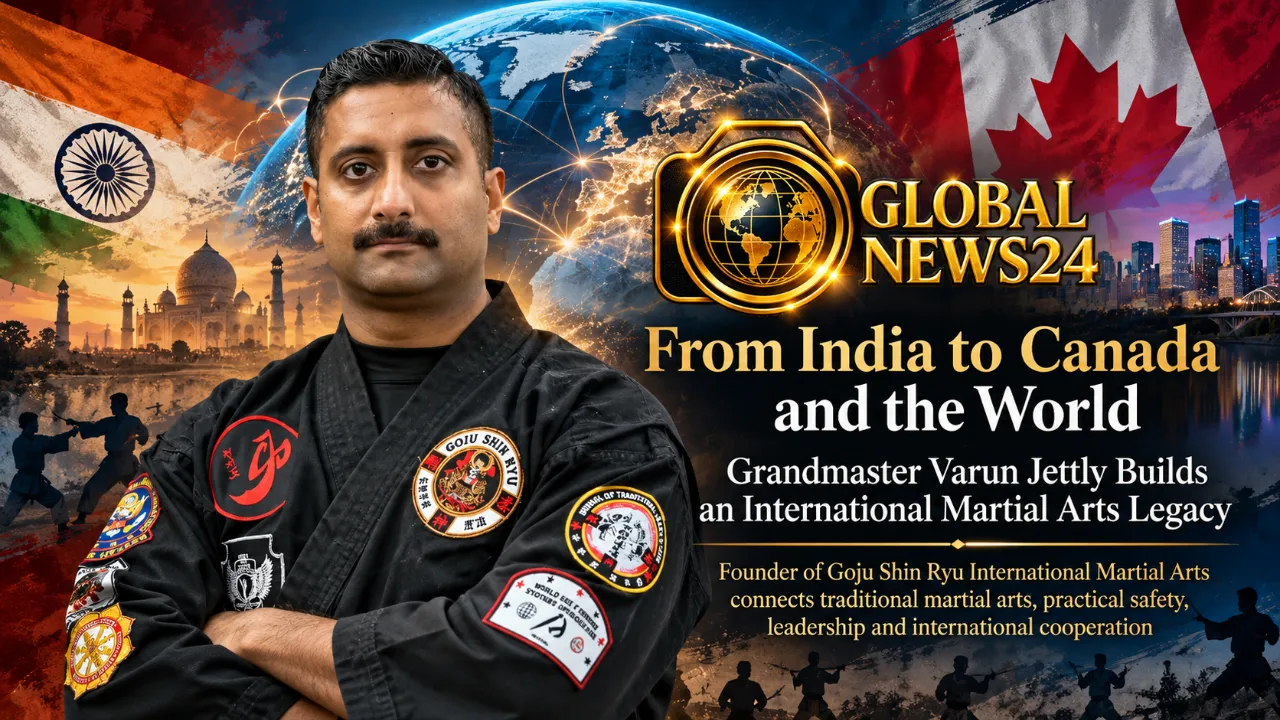
EDMONTON, ALBERTA, CANADA — A martial arts journey that began with determination in India has developed into an international vision extending from Canada to martial arts communities around the world.
Grandmaster Varun Jettly, Founder and Soke of Goju Shin Ryu International Martial Arts and CEO/President of the School of Traditional Martial Arts in Canada, has spent more than 25 years training, teaching and developing martial arts programs and international relationships.
His journey has connected martial artists and organizations across India, Canada, the United States, the United Kingdom, Portugal, Japan and other parts of the international martial arts community.
Today, with Canada serving as the central base of his organization, Jettly continues to develop a martial arts philosophy combining traditional training with practical safety, leadership, responsibility and international cooperation.
A Journey That Began in India
Long before international seminars, organizational leadership and recognition, Jettly’s martial arts journey was built on persistence.
As a young martial artist in India, he traveled long distances to continue his training, including cycling more than 10 kilometres to attend martial arts classes.
Those early experiences helped shape a philosophy emphasizing discipline, perseverance, humility, respect and responsibility rather than physical ability alone.
Over time, his journey expanded from personal training to teaching and organizational development.
The School of Traditional Martial Arts, established in 2001, became an important foundation for his work, combining the preservation of traditional martial arts values with practical skills relevant to modern society.
After establishing his life and martial arts activities in Canada, Jettly continued developing international relationships while working toward a broader martial arts system.
One System. Four Pillars. One Warrior.
That vision developed into Goju Shin Ryu International Martial Arts, a Canadian-based international martial arts system structured around four principal areas.
Traditional Karate Development focuses on martial arts fundamentals, discipline, etiquette, technical development and traditional karate values.
Control & Restraint emphasizes controlled physical skills intended to manage situations responsibly while maintaining safety, restraint and appropriate use of force.
Tactical Defense focuses on practical personal-protection concepts and situational awareness for real-world environments.
Warrior Weapons preserves disciplined weapons education as part of a broader traditional martial arts curriculum.
Together, these four areas are represented by the philosophy:
“One System. Four Pillars. One Warrior.”
For Jettly, the concept of a “warrior” extends beyond fighting ability. It represents an individual capable of combining strength with restraint, confidence with humility, and technical skill with responsibility.
Canada as the International Foundation
Canada has become the central base for the continuing development of Goju Shin Ryu International Martial Arts.
From Edmonton, Alberta, Jettly oversees the organization’s curriculum, international relationships, instructor development, membership structure, certification standards and future expansion.
His Canadian activities also emphasize connecting martial arts with the wider community through personal-safety education, instructor development, leadership training and community programs.
Jettly believes martial arts organizations have a responsibility not only to develop students inside the dojo but also to contribute positively to the communities around them.
India Remains an Important Part of the Vision
Although Canada serves as the international administrative foundation of Goju Shin Ryu, India continues to hold an important place in Jettly’s martial arts journey and future vision.
India was where important foundations of his martial arts life were established, and today the country is also becoming an area for the continuing development of Goju Shin Ryu International Martial Arts.
The organization has been developing training opportunities and organizational representation in India, including martial arts activities in Yamuna Nagar, Haryana.
The longer-term vision is to connect students, instructors and representatives in India directly with the Canadian headquarters and the wider international Goju Shin Ryu network.
Such connections could create opportunities for future seminars, instructor development, grading programs, cultural exchange, international certification and martial arts education.
Building Relationships Across the World
International exchange has remained an important part of Jettly’s martial arts career.
His martial arts experience and professional relationships have extended through Canada, India, the United States, the United Kingdom, Portugal and Japan, with seminars, training experiences, organizational relationships and friendships contributing to his development.
A significant international milestone occurred in Portugal in 2014 as part of his continuing international seminar and teaching experience.
According to profile materials provided to GLOBAL NEWS24, Jettly received recognition through a martial arts Hall of Fame in the United States in 2025.
In March 2026 in Evansville, Indiana, he was formally recognized as Soke/Founder and promoted to 8th Dan, with recognition from senior martial arts leaders O-Sensei Robert Cutrell and Soke Johnny Thompson.
Jettly has frequently acknowledged the importance of teachers, senior Grandmasters and martial arts colleagues who contributed to his development.
Rather than viewing international relationships simply as organizational affiliations, he believes genuine martial arts cooperation should be built on trust, personal respect and long-term friendship.
The Warrior’s Journey
Jettly’s life and martial arts philosophy have also been documented through his published biography, “The Warrior’s Journey – The Life, Vision, and Legacy of Grandmaster Varun Jettly.”
The book follows his journey from a determined young martial artist pursuing training in India to the development of a martial arts organization in Canada with an increasingly international vision.
It explores themes including sacrifice, discipline, perseverance, leadership, mentorship, family, martial arts philosophy and the responsibility of passing knowledge to future generations.
The book also introduces the philosophy and development behind Goju Shin Ryu and its approach to creating a more complete martial arts education.
For Jettly, publishing the book represented another way of preserving not only personal history but also the lessons, relationships and principles that shaped his journey.
Beyond Rank and Recognition
Despite international recognition, Jettly emphasizes that martial arts leadership cannot be measured by rank alone.
Titles and certificates may recognize a particular stage of development, but he believes leadership must ultimately be demonstrated through service, conduct and what an individual contributes to others.
This philosophy has influenced the developing structure of Goju Shin Ryu International Martial Arts.
As Goju Shin Ryu develops internationally, the organization seeks to maintain centralized standards while allowing instructors and representatives in different countries to contribute their own local knowledge, cultures and communities.
A Developing Connection Between Canada and Korea
Another international relationship is now beginning to develop between Canada and the Republic of Korea.
Jettly has been communicating with Grandmaster Jeon Seong Kweon, President of the International Police Martial Arts Federation (IPMA), Founder and President of the World TaekwonKumdo Federation (WTKF), Founder of TaekwonKumdo, and Publisher of GLOBAL NEWS24 in the Republic of Korea.
The communication has included discussions concerning martial arts, international networks, media and possible areas of future exchange.
At this stage, the relationship is developing through communication and mutual understanding, with both sides sharing information about their respective activities and international visions.
GLOBAL NEWS24 could also provide an international media bridge through which martial arts education, community programs, organizational achievements and meaningful international activities from Canada and other countries can be introduced to audiences beyond national boundaries.
Martial Arts as a Bridge Between Nations
Martial arts have long crossed geographical and cultural boundaries.
Techniques may originate in one country, teachers may come from another, and students may eventually carry that knowledge across the world.
Jettly believes this international exchange also carries an important responsibility.
Martial arts organizations should preserve their identity and traditions while remaining open to learning from other cultures, systems and leaders.
When approached with mutual respect, international martial arts cooperation can become much more than competition.
It can create friendships, provide opportunities for young people, connect instructors and educators, encourage cultural exchange and allow martial artists who live thousands of kilometres apart to discover that many of their fundamental values are the same.
Looking Toward the Future
From India to Canada, and from Canada to an expanding international community, Grandmaster Varun Jettly’s journey continues to evolve.
The next phase is not simply about creating a larger organization. It is about creating a stronger international network based on education, integrity, professionalism and genuine relationships.
Goju Shin Ryu International Martial Arts plans to continue developing its programs and international partnerships while maintaining its Canadian foundation and strengthening its presence in India and other countries.
Communication with martial arts leaders in the Republic of Korea represents another developing connection within that international network.
Jettly believes sustainable international relationships should develop naturally:
First, communicate.
Then, build trust.
Then, share knowledge and opportunities.
And finally, allow genuine cooperation to grow.
From a young martial artist pursuing his training in India to an international Grandmaster building a martial arts organization from Canada, the journey continues — and increasingly, that journey is becoming one shared by martial artists across nations.